 USA
 Austria
 Belgium
 Bulgaria
 Croatia
 Cyprus
 Czech Republic
 Denmark
 Estonia
 Finland
 France
 Germany
 Greece
 Hungary
 Ireland
 Israel
 Italy
 Latvia
 Lithuania
 Luxembourg
 Malta
 Netherlands
 Poland
 Portugal
 Romania
 Slovakia
 Slovenia
 Spain
 Sweden
 Ukraine
Abutment Height and Restoration Emergence Angle: Combined Effects on Peri-Implant Bone Loss
(Based on a study in Clinical Oral Implants Research, 2025)
Introduction
Maintaining the marginal bone level around dental implants is a key factor for long-term treatment success. In addition to surgical technique and the quality of osseointegration, bone stability is influenced by the design parameters of the prosthetic components. An international group of researchers conducted a comprehensive retrospective analysis to assess the influence of abutment height and restoration emergence angle on the rate of bone loss and the interaction between these two parameters.
Sample and study design
- Patients: 119 individuals (65 women, 54 men)
- Age: 33 to 91 years (mean: 64.1 years)
- Number of implants: 192
- Implant systems: Various manufacturers, featuring an internal conical connection, platform switching, and diameters of 3.5–5.0 mm.
- Location: Anterior and posterior regions of the maxilla and mandible.
- Inclusion criteria:
- Complete osseointegration of the implant.
- Availability of high-quality CBCT images at the time of prosthesis delivery and at follow-up appointments.
- Absence of active periodontitis or systemic diseases affecting healing.
- Exclusion criteria:
- Implants placed outside the University of Michigan.
- Poor image quality or inadequate visualization of implant/abutment components.
- Tissue-level Implants.
- Active peri-implantitis at inclusion or a history of reconstructive peri-implantitis therapy.
- Implants or patients with missing data regarding implant brand, characteristics, connection type, medical history, or smoking status.
A full list of inclusion and exclusion criteria can be found in the original study.
Radiographic follow-up period: 12 to 18 months post-abutment placement.
Methods of measurement and analysis
- Abutment Height: Measured in millimeters from the implant platform to the restorative margin at the gingival level. Categorized as Short (<2 mm) and Long (≥2 mm).
- Emergence Angle: Determined from sagittal and coronal CBCT sections as the angle between the longitudinal axis of the implant and the outer contour of the restoration in the cervical region. Classified as <30° and ≥30°.
- All cases were divided into four groups:
- Long/Narrow-Angle (LN): TmAH > 2 mm and REA < 30°
- Long/Wide-Angle (LW): TmAH > 2 mm and REA ≥ 30°
- Short/Narrow-Angle (SN): TmAH < 2 mm and REA < 30°
- Short/Wide-Angle (SW): TmAH < 2 mm and REA ≥ 30°
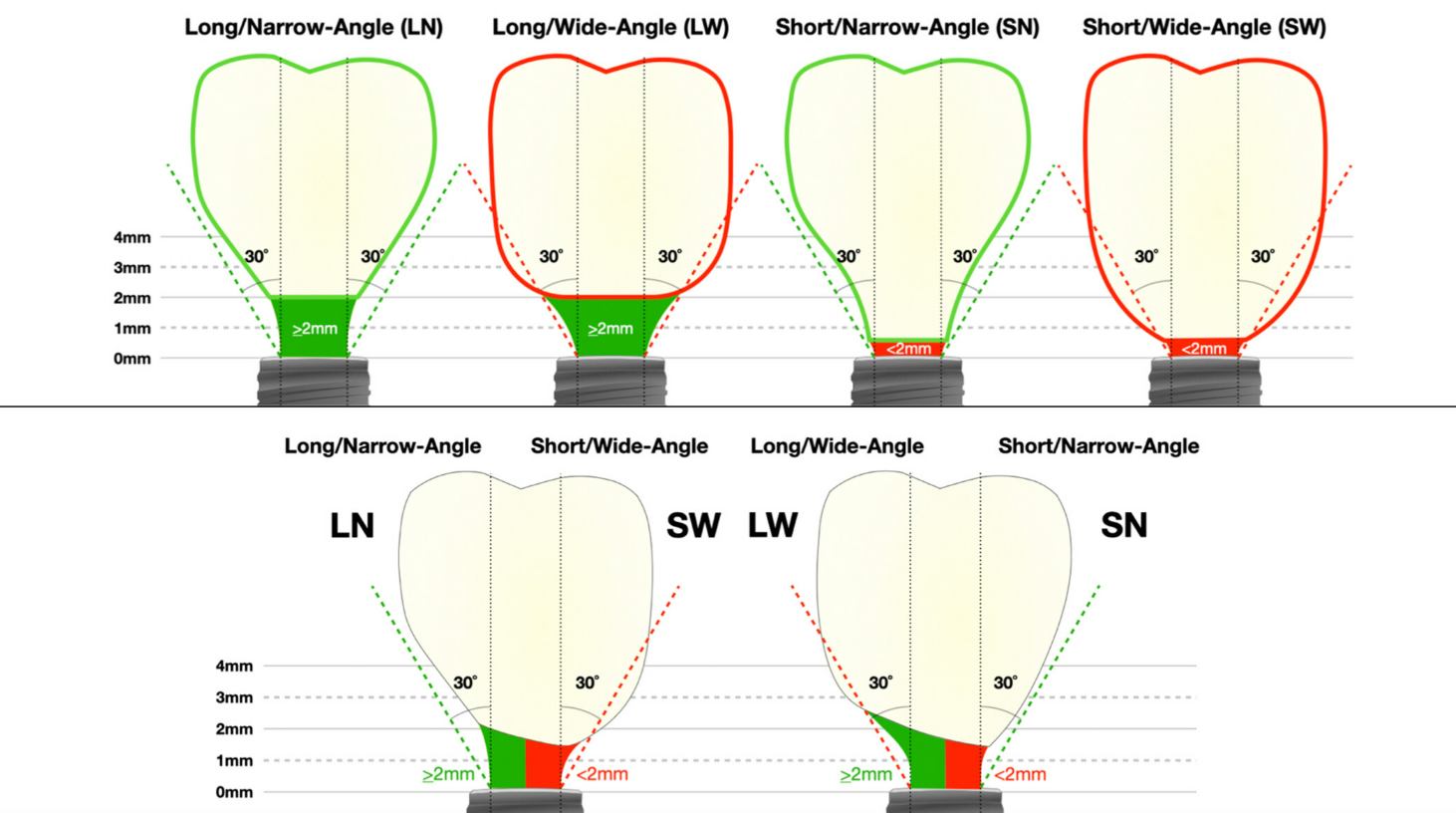
Visual representation of groups. Groups were separated into: Long/Narrow-Angle (LN) (TmAH > 2 mm and REA < 30°), Long/Wide-Angle (LW) (TmAH > 2 mm and REA ≥ 30°), Short/Narrow-Angle (SN) (TmAH < 2 mm and REA < 30°), Short/Wide-Angle (SW) (TmAH < 2 mm and REA ≥ 30°). 1 implant would often present with mesial and distal sites belonging to separate groups. Clinical Oral Implants Research/ clr.14408/ Jonathan Mish/ May 2025
- Measurement of Bone Loss: Assessed via CBCT, from a fixed point on the implant platform to the most coronal point of bone-to-implant contact.
- Statistical Analysis: A multivariate regression analysis was performed, accounting for age, gender, location, smoking, and bone density.
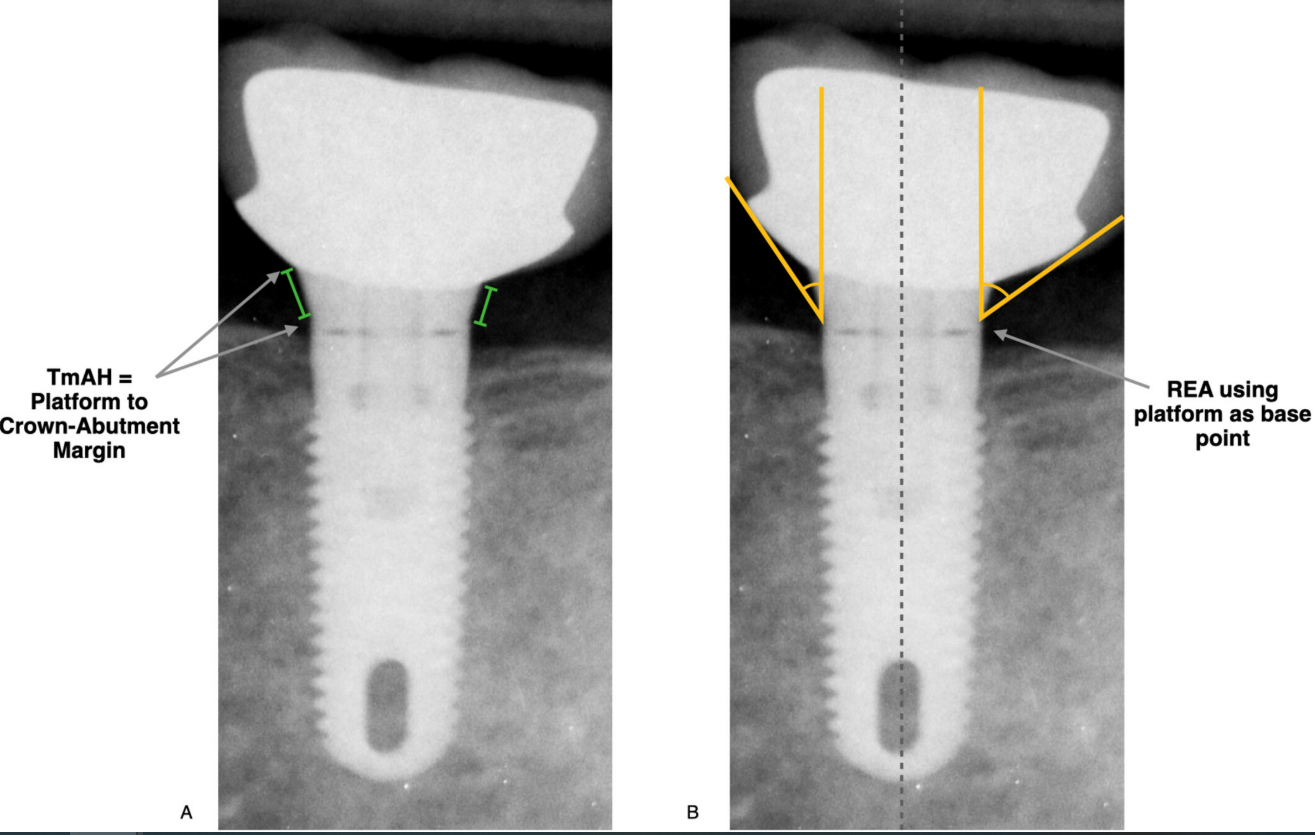
Example of the assessment of transmucosal abutment height (TmAH) and restorative emergence angle (REA): (A) an example of the assessment of TmAH; (B) an example of the assessment of REA. Clinical Оral implants Research/ clr.14408/ Jonathan Mish/ May 2025
Results
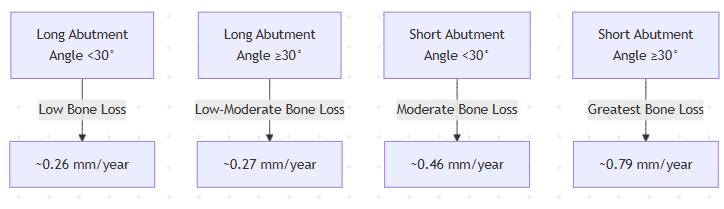
- Synergistic Effect: The greatest mean annual bone loss was observed with the combination of a short abutment and a wide emergence angle (≥30°), averaging 0.79 mm/year (±0.05).
- Protective Effect of Height: For abutments ≥2 mm (Long), the differences in bone loss between narrow and wide angle groups were not statistically significant. The long abutment mitigated the negative impact of a wide emergence angle.
- A narrow emergence angle (<30°) stabilized the bone level even with a short abutment, with an average loss of 0.19 mm/year.
- Location: In the posterior mandible, the effect of the unfavorable combination (short abutment + wide angle) was more pronounced than in the anterior region.
- Timeline: The most significant difference in bone loss rates emerged after 12–18 months and persisted throughout the observation period.
Interpretation
- A long abutment provides more vertical space for the formation of soft tissue attachment. If this space is insufficient, the body resorbs marginal bone to establish the necessary biologic width.
- A narrow emergence angle (<30°) creates a more gradual restorative contour, which facilitates oral hygiene and reduces soft tissue compression in the cervical region, also preserving space for the biologic width.
- An unfavorable combination (short abutment + wide angle) not only promotes marginal bone resorption to create biologic width but also creates a zone of increased tissue compression and impairs hygiene access, which can accelerate marginal bone loss.
Implications for practicing dentists
During surgical planning:
- Whenever possible, position the implant platform at a sufficient depth to allow for an abutment height of ≥2 mm.
- If vertical bone is limited, design the restorative contour to ensure the emergence angle in the cervical area is <30°.
- In esthetically demanding areas, if a wider emergence angle is necessary, compensate by using a longer abutment or a custom-designed abutment.
During prosthetic design:
- Evaluate the anticipated emergence profile, even at the provisional restoration stage.
- Avoid abrupt changes in diameter or “step” designs in the cervical area.
- With a wide emergence angle, design the restoration to facilitate easier cleaning of interproximal spaces.
When working with existing restorations:
- If an unfavorable combination of parameters and initial bone loss are identified, consider replacing the abutment with a taller one.
- Reinforce oral hygiene protocols and increase the frequency of professional cleanings.
Summary of relationships
Conclusions
- Marginal bone loss depends not only on abutment height and emergence angle individually, but on their combination.
- The greatest risk is associated with short abutments and wide emergence angles; these combinations should be avoided during treatment planning.
- Using a taller abutment or creating a narrower emergence angle can compensate for the unfavorable effect of the other parameter.
- These findings are applicable to both single crowns and fixed partial dentures and are critical for the long-term stability of peri-implant tissues.