 USA
 Austria
 Belgium
 Bulgaria
 Croatia
 Cyprus
 Czech Republic
 Denmark
 Estonia
 Finland
 France
 Germany
 Greece
 Hungary
 Ireland
 Israel
 Italy
 Latvia
 Lithuania
 Luxembourg
 Malta
 Netherlands
 Poland
 Portugal
 Romania
 Slovakia
 Slovenia
 Spain
 Sweden
 Ukraine
Savings Without Compromise: How One Implant Retained a Prosthesis for a Decade
Contents
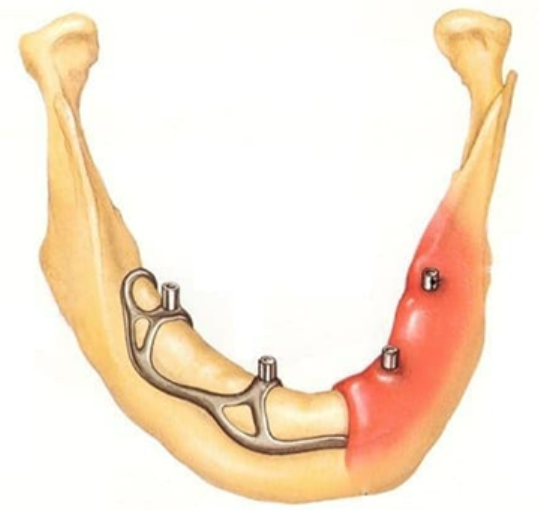
Complete edentulism remains one of the most challenging clinical problems in dentistry. Despite advances in prosthetics and implantology, a significant proportion of older patients continue to use traditional removable dentures, which often fail to provide sufficient stability and comfort. In the search for more accessible and less invasive solutions, the concept of the Single Implant Mandibular Overdenture (SIMO)—a lower jaw prosthesis retained by just one implant placed in the midline—has emerged.
The idea seemed risky: one implant instead of two or four, no prosthetic reinforcement, and minimal surgical intervention. However, initial clinical observations showed that even this “economical” option can significantly improve prosthetic retention and patients’ quality of life. For elderly people with limited financial resources, SIMO has become a viable alternative to expensive multi-component systems.
Until recently, there was little long-term data on this technique. That is why a study conducted by a team of researchers—Xotchil Lourdes Tellez Flores, Lays Noleto Nascimento, Thalita Fernandes Fleury Curado, Túlio Eduardo Nogueira, Murali Srinivasan, and Cláudio Rodrigues Leles—deserves special attention. Over the course of 8–10 years, they followed two cohorts of patients (74 in total) who received a single implant in the mandibular symphysis region. The aim of the study was to evaluate not only implant survival but also quality of life, implant stability, peri-implant tissue condition, and the incidence of prosthetic complications.
For practicing clinicians, this study is important for two reasons. First, it provides rare data on how SIMO performs in real-world clinical practice over nearly a decade. Second, it reveals the most common problems and how often patients will need to return for prosthetic maintenance.
Materials and methods
The study was designed as a prospective cohort study and conducted in accordance with international standards (STROBE). It included 74 patients (42 in the first cohort, 32 in the second), observed over the course of 8–10 years after implant placement. Participants ranged in age from 47 to 86 years (mean 64.7 years), and the majority were women (73%). All patients were completely edentulous and used traditional dentures prior to treatment.
Treatment protocol
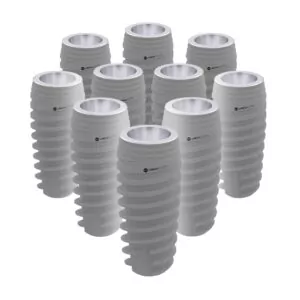
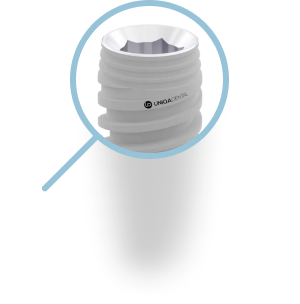
- Placement of one implant with a diameter of 3.75 mm (Neodent, Brazil) in the mandibular symphysis region.
- The surgery was minimally invasive and single-stage.
- Immediate loading was used when ISQ > 60 and torque > 30 Ncm—this was the case for 93.2% of patients (69 individuals).
- In the remaining cases (6.8%), delayed loading was applied.
- To retain the prosthesis, a ball abutment with a nylon matrix (O-ring attachment) was used.
- The prostheses had no reinforcement (no metal frameworks or fibers).
The evaluation of results was carried out at different stages (from 3 months to 10 years) and included:
- Quality of life (OHIP-Edent).
- Satisfaction with the prosthesis (VAS scale).
- Implant stability (ISQ).
- Soft tissue condition (bleeding index, plaque index).
- Bone level (digital radiographs).
- Prosthetic complications (matrix replacement, fractures, relining, etc.).
Key study parameters
| Parameter | Value |
|---|---|
| Number of patients | 74 |
| Age | 47–86 years (mean 64.7) |
| Women | 73% |
| implant | Neodent, 3.75 mm, symphysis |
| Immediate loading | 93.2% |
| Delayed loading | 6.8% |
| Attachment system | Ball abutment + O-ring |
| Reinforcement of the prosthesis | No |
| Follow-up period | 8–10 years |
Thus, the study was designed to closely approximate real-world clinical practice: simple surgery, accessible components, and no additional prosthetic reinforcement. This allows us to assess how reliably SIMO performs in a typical dental office setting.
Results
Implant survival
- The overall survival rate was 95.6% over a follow-up period of 8–10 years.
- Of the 74 patients, only three experienced serious complications requiring implant replacement or abandonment of the SIMO treatment.
- Immediate loading has been shown to be highly effective, but isolated cases of complications confirm the need for careful patient selection.
Quality of life and satisfaction
- OHIP‑Edent: a decrease in scores from ~30 points at the initial stage to ~7 points after 8–10 years.
- Prosthesis satisfaction (VAS): an increase from ~40 to ~88 points over the same period.
- The improvements were statistically significant (p<0.001) and were maintained throughout the follow-up.
-
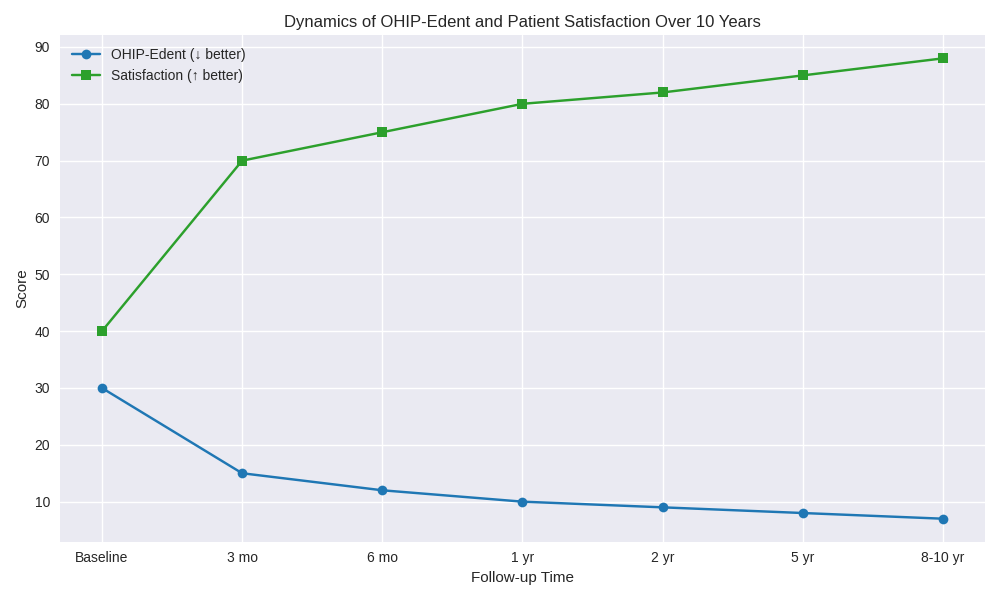
Dynamics of OHIP-Edent and patient satisfaction scores during long-term follow-up of single implant mandibular overdenture treatment.
Bone changes and stability
- Average bone resorption:
- -0.68 mm in 1 year.
- -1.55 mm in 8-10 years.
- The condition of the soft tissues remained favorable: a decrease in the bleeding index and stable plaque levels.
- ISQ demonstrated consistent implant stability, although a slight decrease was noted toward the end of the follow-up period.
Prosthetic complications
The most common events:
- Matrix replacement—43.3% of cases (259 episodes).
- Prosthesis fracture—12.4% (74 episodes).
- Other complications: Loosening of attachments (6.5%), relining (5.5%), fabrication of new prostheses (3.7%).
Key Results Table
| Parameter | Value |
|---|---|
| Implant survival | 95.6% |
| Bone resorption in 1 year | -0.68 mm |
| Bone resorption in 8–10 years | -1.55 mm |
| Matrix replacement | 43.3% |
| Prosthesis fracture | 12.4% |
Thus, SIMO has proven to be a reliable solution for completely edentulous patients: improved quality of life and high implant survival rates have been maintained for a decade. However, regular maintenance remains essential, particularly due to the high frequency of matrix replacements and the risk of prosthesis fractures.
Discussion
The long-term results of the study confirm: SIMO is a viable and reliable concept, which can significantly improve the lives of patients with complete edentulism. It is important to understand that the success of this method requires regular maintenance visits.
Comparison with other studies
- Yazigi (2025): A follow-up of up to 15 years resulted in a high survival rate (100%), but frequent prosthesis fractures and the need for regular matrix activation were noted. This confirms the findings of the current study: implant longevity does not eliminate prosthetic problems.
- Liddelow (2024): Involved 29 patients with 15 years of follow-up, demonstrating 100% survival and high satisfaction. However, the need for regular maintenance was also noted.
- Kern (2021): Showed that immediate loading reduces survival (84.7% versus 96.2% with delayed loading). In our study, immediate loading was used in the majority of patients, and although overall survival was high (95.6%), individual complications confirm the risk.
Practical significance for the physician
- SIMO provides prosthetic stability and improved quality of life even with minimal surgical intervention.
- The main problem is frequent prosthetic complications, especially matrix replacement (on average, annually).
- Patients should be informed in advance about the need for regular maintenance visits.
- Immediate loading is possible but requires careful patient selection and close monitoring.
Thus, SIMO can be viewed as an affordable and reliable solution for elderly patients, especially those with financial constraints. However, the clinician must consider the high risk of prosthetic complications and plan for long-term follow-up.
Conclusions
- SIMO is a reliable concept: One implant in the symphysis area ensures long-term retention of the prosthesis and improves the quality of life for patients.
- High implant survival rate: 95.6% over 8–10 years of follow-up—a figure comparable to more complex protocols.
- Clinical effect: A significant reduction in OHIP-Edent scores and an increase in prosthesis satisfaction were maintained throughout the follow-up period.
- Bone changes: moderate resorption (-1.55 mm over 10 years), which is not critical for functionality.
- Main problems: frequent matrix replacement (43.3%) and prosthesis fractures (12.4%), which require regular visits and maintenance.
- Practical significance: The method is especially useful for elderly patients with limited financial resources, but the clinician should inform them in advance about the need for regular monitoring.
- Context of other studies: Data from Yazigi (2025) and Liddelow (2024) confirm high survival and satisfaction, while Kern (2021) reminds us of the risks of immediate loading.
Thus, SIMO can be viewed as an affordable and clinically proven solution, which combines the simplicity of surgery with long-lasting results. However, the success of this method depends directly on systematic monitoring and the patient’s commitment to regular prosthetic maintenance.

-
Hot
-
Hot
-
-