 USA
 Austria
 Belgium
 Bulgaria
 Croatia
 Cyprus
 Czech Republic
 Denmark
 Estonia
 Finland
 France
 Germany
 Greece
 Hungary
 Ireland
 Israel
 Italy
 Latvia
 Lithuania
 Luxembourg
 Malta
 Netherlands
 Poland
 Portugal
 Romania
 Slovakia
 Slovenia
 Spain
 Sweden
 Ukraine
Implants: Titanium vs. Zirconia. Survival Rates and Complications of Hybrid Crowns on Titanium and Zirconia Implants: Results of a Three-Year Study
Contents
🔗 Link to the original study:
Sterzenbach G. et al. (2025). A Randomised Controlled Trial Evaluating 3-Year Survival Rates and Technical Complications of Screw-Retained Hybrid Abutment Crowns on Two-Piece Zirconia and Titanium Implants.
Clinical Oral Implants Research.https://doi.org/10.1111/clr.14443
Purpose of the study
A group of researchers from the University of Freiburg (Germany) aimed to evaluate the three-year survival rate and technical complications of screw-retained hybrid crowns placed on implants made of titanium and zirconium dioxide (ZrO₂).
The study was a randomized controlled trial (RCT) and is one of the first to provide long-term observation of the clinical performance of two-piece zirconia implants used with hybrid abutments.
How the study was organized
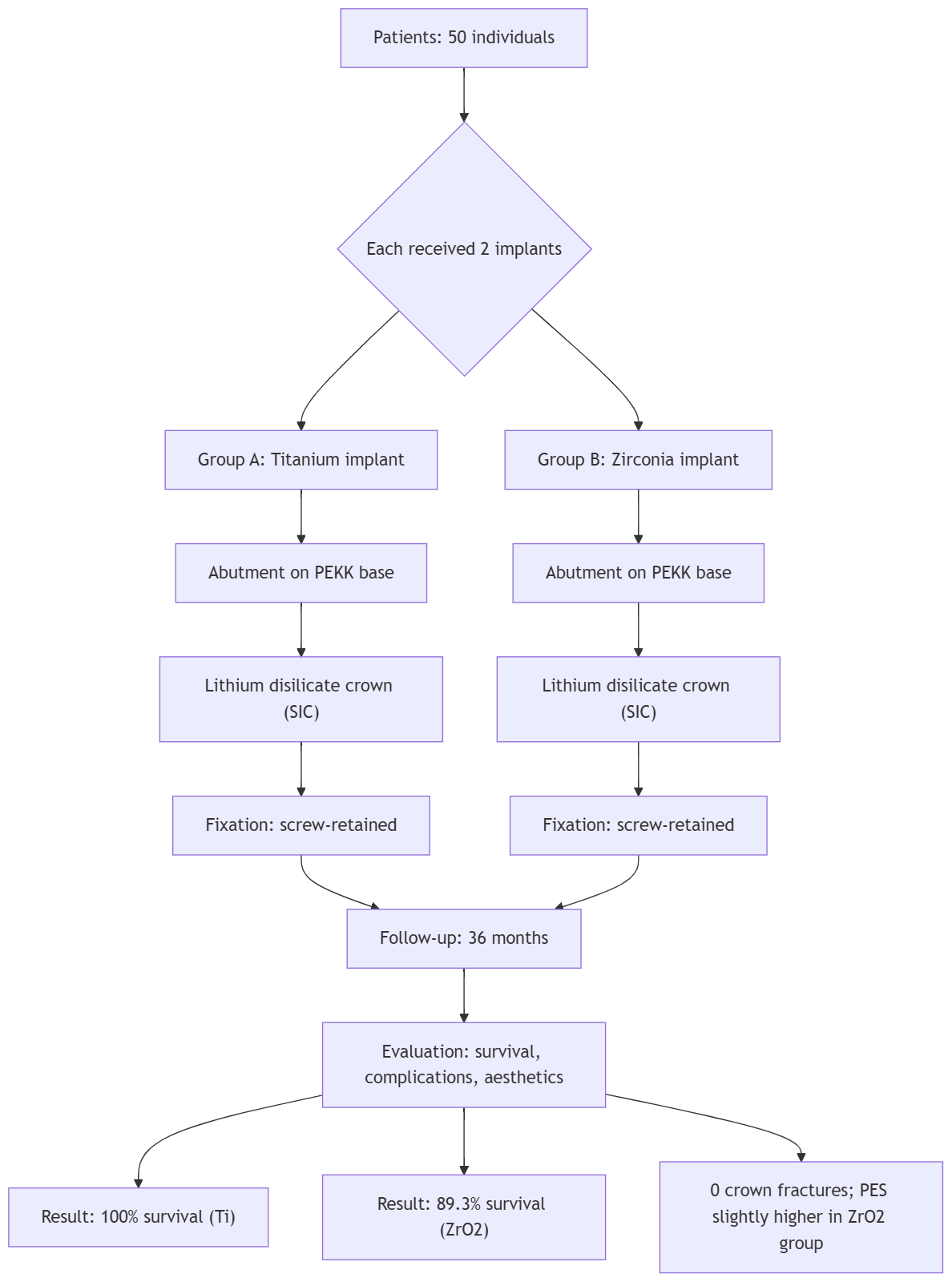
The study involved 50 patients, each of whom received two implants: one made of titanium and the other of zirconia.
Combinations of materials
| Group | implant | Abutment | Crown | Fixation type |
|---|---|---|---|---|
| A (Ti) | Titanium (two-piece) | PEKK-based | Lithium disilicate crown (SIC) | Screw-retained |
| B (ZrO₂) | Zirconium dioxide (two-piece) | PEKK-based | Lithium disilicate crown (SIC) | Screw-retained |
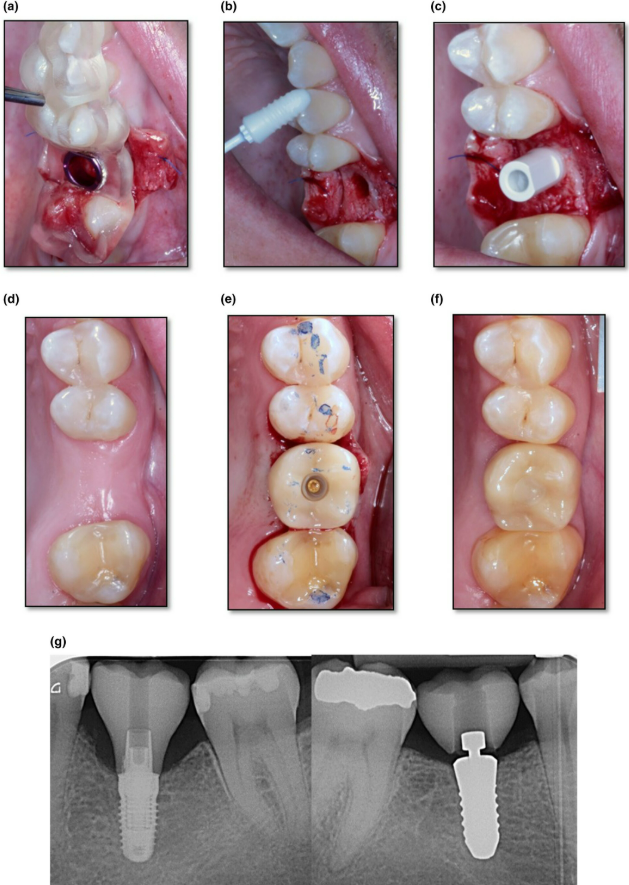
Clinical example of workflow (a) template for guided pilot drilling; (b) intraoral view before placement of CERALOG HL implant; (c) intraoperative Scanpost; (d) clinical situation after submerged Implant healing; (e) second-stage surgery with split flap and final crown SIC of the CERALOG HL group; (f) finished SIC at baseline; and (g) radiograph of the finished SIC of the titanium and zirconia groups. Wiley online library/ Guido Sterzenbach /10.1111/clr.14443 /April 2025
Why were these combinations chosen?
Before the experiment began, it was expected that:
- Zirconia implants would provide better aesthetics and biocompatibility.
- Titanium implants would exhibit higher mechanical stability.
- The hybrid PEKK abutment would absorb masticatory forces, reducing the risk of ceramic chipping.
Thus, the researchers investigated whether the “zirconia + PEKK + lithium disilicate” combination could be a viable alternative to the traditional titanium-based system.
How were the results assessed?
The study lasted 36 months.
Key parameters included:
- Implant survival rate
- Crown (SICs) survival rate
- Frequency of technical complications (e.g., chipping, screw loosening, abutment fractures)
- Pink Esthetic Score (PES)
- Biological complications (e.g., inflammation, peri-implantitis)
Results after 3 years
| Indicator | Titanium group (A) | Zirconia group (B) | Difference / comment |
|---|---|---|---|
| Implant survival rate | 100% | 89.3% | 10.7% lower in the ZrO₂ group |
| Crowns (SICs) survival rate | 100% | 100% | No crown failures were recorded |
| Technical complications | 0% | 10% | Several cases of screw loosening and micro-fractures |
| Pink Esthetic Score (PES) | 12.1 ± 1.0 | 13.2 ± 0.9 | Slightly higher in the ZrO₂ group |
| Biological complications | 0 | 1 case of mild inflammation | Did not affect overall survival |
Visual diagram of the experiment
What was confirmed and what was not
✅ Confirmed
- Titanium implants continue to show excellent reliability: zero failures over three years.
- Using a PEKK abutment proved to be an effective solution for both groups—no crowns failed, regardless of the implant material.
- The aesthetics of zirconia implants were indeed slightly better, resulting in a more natural gum color and avoiding the “grayish” translucency sometimes seen with titanium.
❌ Not confirmed
- Hopes for an equal survival rate of zirconia implants did not come true: Failures amounted to more than 10%, primarily in the first few months after placement.
- Technical complications (screw loosening, micro-fractures at the connection) were more frequent with ZrO₂ implants.
- Theory of complete bioinertness of zirconia was not confirmed either, as one case of peri-implant tissue inflammation was recorded in the zirconia group.
Interpretation: Why zirconia lost to titanium
The researchers attribute the difference to the mechanical properties of the materials.
- Titanium has high ductility and toughness, allowing it to absorb masticatory micro-impacts.
- Zirconia, being harder and more brittle, is less effective at compensating for stress at the implant-abutment connection, which increases the risk of micro-fractures and component loosening.
Thus, the strength of the material itself does not guarantee the stability of the entire system.
What role did PEKK play?
The use of PEKK abutments was a key element of the study. This material is structurally similar to PEEK but contains an additional carbonyl group, making it tougher and more thermally stable.
Benefits noted by the authors:
- High elasticity → Acts as a shock absorber, reducing the risk of chipping the ceramic crown.
- Biocompatibility → No adverse inflammatory reactions were observed.
- Ease of modification or repair if complications arise.
In essence, PEKK served as a “shock absorber” between the ceramic crown and the implant, ensuring a more forgiving load transfer.
Aesthetic aspect (PES)
The Pink Esthetic Score (PES) was slightly higher in the zirconia implant group (+1 point on average). This is attributed to the warmer, tooth-like shade of zirconia, which prevents a grayish hue from showing through the gingiva. However, the authors emphasize that this difference was not statistically or clinically significant.
Key findings
- Titanium remains the benchmark for durability, with zero implant loss over three years.
- Zirconia showed a lower survival rate, with a 10.7% failure rate.
- PEKK abutments demonstrated excellent performance with both implant types, preventing crown fractures and chipping.
- The aesthetics of zirconia are indeed superior, but the difference may not justify the compromise in mechanical reliability.
Conclusion
The study by Sterzenbach et al. serves as an important reminder for implantologists: aesthetics should not come at the expense of mechanical reliability. While zirconia remains a promising material, particularly in the esthetic zone, titanium’s performance under full masticatory load is currently unrivaled.
Hybrid restorations using PEKK abutments represent a trend that combines the best of both worlds: aesthetics, durability, and a forgiving interaction with ceramics.

-
Hot
-