 USA
 Austria
 Belgium
 Bulgaria
 Croatia
 Cyprus
 Czech Republic
 Denmark
 Estonia
 Finland
 France
 Germany
 Greece
 Hungary
 Ireland
 Israel
 Italy
 Latvia
 Lithuania
 Luxembourg
 Malta
 Netherlands
 Poland
 Portugal
 Romania
 Slovakia
 Slovenia
 Spain
 Sweden
 Ukraine
Effect of the Buccal Gap Width on Alveolar Process Reduction Following Immediate Implant Placement: A Retrospective CBCT Study
Contents
Extracting a tooth in an esthetic zone of the maxilla is always a challenge for the dentist. Patients expect not only functional restoration but also the preservation of a harmonious smile. However, nature dictates its own laws: after extraction, the alveolar process inevitably undergoes resorption. Even immediate implant placement, which seems a logical way to preserve bone volume, is not able to completely stop this process.
That’s why researchers are looking for factors that can influence the degree of alveolar ridge preservation. One such factor is the width of the so-called “buccal gap”—the space between the implant and the inner wall of the socket. The question is simple: does a wide buccal gap provide advantages in maintaining the thickness of the buccal wall? Certainly not in itself, but rather when grafted with a bone substitute, compared to a narrow gap.
In 2026, a group of researchers led by Mauricio Araujo presented a retrospective study dedicated to this issue. It served as the basis for this article. The authors aimed to evaluate how buccal gap width affects alveolar bone preservation after immediate implant placement of a maxillary central incisor.
The results were revealing. The study included a key phrase: “A buccal gap > 2-mm wide grafted with DBBM after IIP may preserve more than 90% of the dimensions of the alveolar process.”
In other words, if the space between the implant and the socket wall was wide enough and filled with a bone substitute, it was possible to preserve almost the entire volume of the alveolar process.
Thus, the issue of gap width is no longer a purely technical detail of the surgical protocol. It has become a factor that can determine the long-term success of treatment and the esthetics of the patient’s smile.
Materials and methods
To evaluate the effect of buccal gap width on alveolar bone preservation, the researchers chose a retrospective design. The analysis included 28 patients who underwent immediate implant placement of a maxillary central incisor.
Inclusion criteria
- Over 21 years of age, good general health, and good oral hygiene.
- The presence of one compromised central incisor indicated for extraction and an intact buccal wall of the socket.
- Presence of a healthy contralateral tooth for comparison.
- Documented clinical photographs and CBCT at least 2 years after treatment.
Exclusion criteria
- Absence of a contralateral tooth.
- Peri-implantitis during the follow-up period.
- Systemic diseases or medications affecting bone metabolism.
- Smoking more than 5 cigarettes a day.
Treatment protocol
- Atraumatic tooth extraction.
- Implant placement using a surgical guide.
- Grafting the buccal gap with DBBM (deproteinized bovine bone mineral) particles.
- Use of a connective tissue graft (CTG) if gingival thickness was <1 mm.
- Postoperative care: antiseptic rinses, antibiotics, and suture removal after 2–3 weeks.
- The definitive crown was placed after 5–6 months.
Division into groups
- Wide gap: >2 mm (14 patients).
- Narrow gap: ≤2 mm (14 patients).
Patient characteristics table
| Parameter | Wide gap (>2 mm) | Narrow gap (≤2 mm) |
|---|---|---|
| Mean age | 62.6 ± 16.7 years | 52.1 ± 13.4 years |
| Female | 57.1% | 71.4% |
| Time in function | 7.1 ± 4.7 years | 5.1 ± 3.4 years |
| Straumann implants | 78.6% | 100% |
| Use of CTG | 64.3% | 57.1% |
After a 3-month healing period, soft tissue conditioning began with a screw-retained provisional crown, and the definitive ceramic crown was placed 2–3 months later. Patients were enrolled in an individualized supportive periodontal therapy program, which included oral hygiene instructions, rubber cup prophylaxis, and scaling of bleeding sites. At the final examination (6 ± 4 years later), patients underwent CBCT scanning. Demographic data (age, gender, medical and dental history) were obtained from dental charts for analysis.
Thus, the study was carefully designed: the groups were comparable in key characteristics, and the difference lay specifically in buccal gap width. This allowed the authors to objectively assess the impact of this factor on long-term outcomes.
Results
The study showed that the width of the buccal gap plays a key role in preserving the alveolar bone after immediate implant placement.
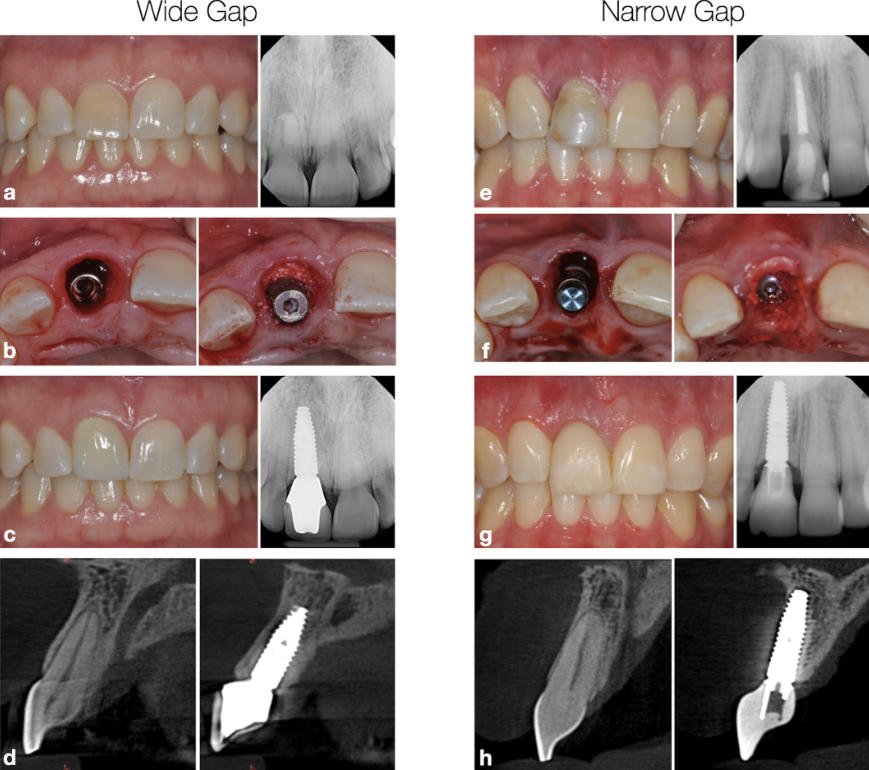
Case scenarios in the wide (a-d) and narrow (e-h) Gap groups. Clinical and radiographic presentation, the maxillary central incisors were indicated for extraction (a, e). The implants were placed with a surgical guide and the gap between the implants and the inner aspect of the buccal wall was measured and filled with DBBM (b, f). Both cases received a CTG at the buccal aspect of the implants. Clinical and radiographic aspect after 2 years in function (c, g). Cross-sectional CBCT reconstructions obtained at 2 years of follow-up, acquired with a 1-mm slice thickness, and standardized field of view and scale across both sites. Comparison between the contralateral tooth sites and implant sites (d, h). Observe that the implant ridge seemed successfully preserved in the wide gap group, while a substantial reduction is noted in the narrow gap group.
Main findings
- Narrow gap (≤2 mm): The mean resorption was 41.1% ± 20.2%.
- Wide gap (>2 mm): Resorption was significantly lower — a total of 8.5% ± 11%.
- The thickness of the buccal wall in the wide gap group reached 2.1 mm, whereas in the narrow gap group it was only 0.5 mm.
- The height of the buccal wall was also better preserved with a wide gap: a total decrease of 1.1%, compared to 51.7% in the narrow gap group.
Quote from the study
“A buccal gap >2-mm wide grafted with DBBM after IIP may preserve more than 90% of the dimensions of the alveolar process.”
Table: Comparison of narrow and wide gaps
| Indicator | Wide gap (>2 mm) | Narrow gap (≤2 mm) |
|---|---|---|
| Alveolar ridge resorption | 8.5% | 41.1% |
| Buccal wall thickness | 2.1 mm | 0.5 mm |
| Decrease in the height of the buccal wall | 1.1% | 51.7% |
| Preservation of alveolar ridge dimensions | >90% | <60% |
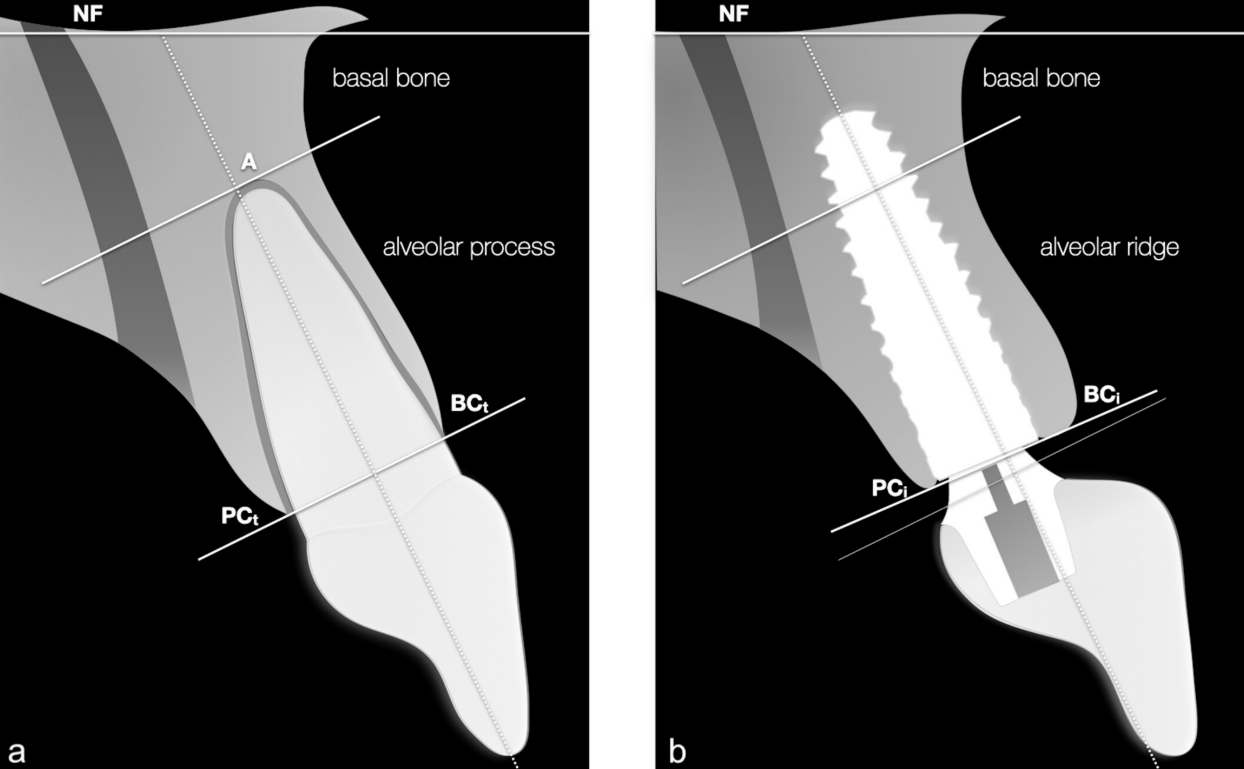
Illustration of the alveolar process and basal bone borders determined in the cross-sectional reconstructions at the tooth and implant sites. A: apex; BC: buccal crest; NF: nasal fossa; PC: palatal crest.
Thus, the results of the study convincingly show that the width of the buccal gap is a critical factor for the long-term preservation of the alveolar process.
Discussion
The results of the study by Araujo and colleagues showed that the width of the buccal gap is not just a technical detail, but a factor that can determine the fate of the implant and the esthetics of the patient’s smile for years to come.
Key observations
- With a wide gap (>2 mm), it was possible to preserve more than 90% of the original dimensions of the alveolar process.
- With a narrow gap (≤2 mm), there was pronounced resorption — approximately 41%.
- The buccal wall thickness in the wide gap group was four times greater than that in the narrow gap group.
These data confirm the authors’ hypothesis: the larger the space for the integration of the bone substitute, the higher the chance of stable preservation of bone volume.
Clinical significance
For dentists, this means that gap width can be an indicator of long-term prognosis. Although the researchers don’t make direct recommendations, their findings clearly indicate that a narrow gap is associated with a risk of significant resorption and loss of esthetics.
Quote from the study
“Conversely, a grafted narrow gap frequently results in significantly reduced ridge preservation.”
Thus, the gap width becomes a kind of “biological marker” of success: it determines how predictable the result of immediate implant placement in the esthetic zone will be.
Conclusions
A study by Araujo and colleagues convincingly demonstrated that the width of the buccal gap during immediate implant placement of a maxillary central incisor directly influences the preservation of the alveolar process.
Key figures
- Wide gap (>2 mm): resorption of only 8.5%, preserving more than 90%of the dimensions.
- Narrow gap (≤2 mm): resorption of around 41%, with a significant decrease in the thickness and height of the buccal wall.
- Buccal wall thickness: 2.1 mm with a wide gap versus 0.5 mm with a narrow gap.
Final thought
The width of the gap proved to be a decisive factor: “Conversely, a grafted narrow gap frequently results in significantly reduced ridge preservation.”
Thus, the study demonstrates that it is the anatomical conditions – and not just the technique or material – that determine the long-term success of immediate implant placement.
Source
Effect of the Buccal Gap Width on Alveolar Process Reduction Following Immediate Implant Placement: A Retrospective CBCT Study – Maurício G. Araújo, Debora R. Dias, Ping Wang, Robert A. Levine – published in CLINICAL ORAL IMPLANTS RESEARCH 13 March 2026 https://doi.org/10.1111/clr.70106
We hope you found this article useful. Stay tuned for the next publication.

-
Hot
-
Hot
-
-