 USA
 Austria
 Belgium
 Bulgaria
 Croatia
 Cyprus
 Czech Republic
 Denmark
 Estonia
 Finland
 France
 Germany
 Greece
 Hungary
 Ireland
 Israel
 Italy
 Latvia
 Lithuania
 Luxembourg
 Malta
 Netherlands
 Poland
 Portugal
 Romania
 Slovakia
 Slovenia
 Spain
 Sweden
 Ukraine
Effect of Early Radiographic Bone Loss Before Loading on Implant-Related Outcomes: A Long-Term Retrospective Study
Contents
Implant therapy has long been the standard for restoring missing teeth, providing patients with a high quality of life and predictable results. However, as the number of placed implants increases, the problem of complications—primarily peri-implant diseases and progressive bone resorption—is becoming increasingly pressing. Therefore, we present a review of a study conducted by Dr. Dominik Moser and his team based on statistical data obtained at the Department of Oral Surgery and Stomatology at the School of Dental Medicine, University of Bern, between January 2000 and January 2020.
According to systematic reviews, peri-implant mucositis occurs in 59–63% of patients, while peri-implantitis occurs in 18–25% of cases. These figures indicate that even with successful osseointegration, the risk of long-term complications remains high.
In recent years, a specific phenomenon has attracted particular attention: early radiographic bone loss (ERBL)—changes recorded even before the final prosthesis is placed. While it was previously believed that the bone level after prosthetic loading was critical, researchers are now increasingly asking: can early resorption serve as a predictor of future problems?
This is precisely the hypothesis that a group of researchers from Bern, Michigan, and Granada tested. Their retrospective study, which included more than two hundred patients and over 260 implants, aimed to determine whether ERBL affects long-term outcomes—progressive bone loss, implant survival, and the development of peri-implant diseases.
Thus, this work lays the foundation for understanding the extent to which early changes in bone level can determine the fate of an implant over a 5–10-year period. For practicing clinicians, this opens the possibility of taking a fresh look at the monitoring and diagnostic stages.
Materials and methods
The study was conducted as a retrospective cohort study, in accordance with international standards (STROBE) and the principles of the Declaration of Helsinki. The authors analyzed the medical records of patients who received implants at the University of Bern Clinic between 2000 and 2020.
Sample:
- In total, more than 5,000 patient records were reviewed, resulting in a final sample of 221 patients with 261 implants.
- The ERBL+ group included 87 implants in 57 patients where early radiographic bone loss (exposure of the rough surface of the implant) was recorded before the placement of the final prosthesis.
- The ERBL- group consisted of 174 implants in 164 patients without signs of early resorption.
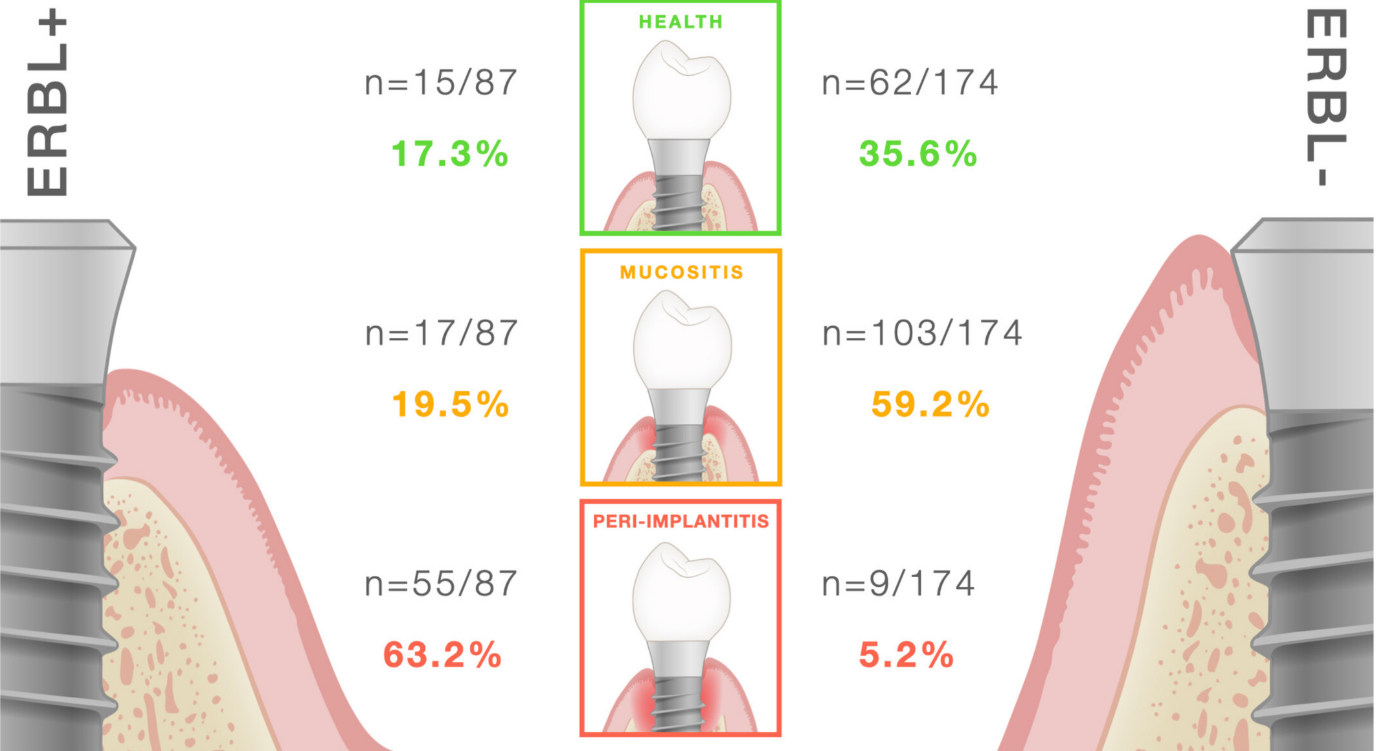
Proportion of implant sites presenting peri-implant health, peri-implant mucositis, and peri-implantitis in each group (Exposure: ERBL+/Non-exposure: ERBL−); ERBL: early radiographic bone loss, defined as apical migration of the interproximal marginal bone involving exposure of the implant rough surface before insertion of the final prosthesis.
Inclusion criteria:
- Age ≥18 years.
- Availability of high-quality periapical radiographs.
- Documentation of at least 5 years of follow-up.
- For ERBL+: confirmed apical migration of the interproximal bone before prosthesis placement.
- For ERBL-: no exposure of the rough surface of the implant.
Data collected:
- Medical history (smoking, diabetes, osteoporosis, medication use).
- Dental history (periodontitis, number of implants).
- Implant characteristics (type — bone-level or tissue-level, diameter, length, type of restoration).
- Surgical parameters (operator experience, placement technique, use of antibiotics and sedatives).
- Clinical parameters (implant survival, bleeding on probing, presence of suppuration, probing depth).
- Radiographic measurements: marginal bone level relative to the implant shoulder before prosthetic loading and at the final follow-up.
Definitions:
- Peri-implantitis — inflammation of the peri-implant mucosa with progressive loss of supporting bone.
- Peri-implant mucositis — inflammation of the soft tissues without bone resorption.
- ERBL — early radiographic bone loss before prosthetic loading.
- PBL — progressive bone loss during long-term follow-up.
Statistics:
Linear mixed models and generalized estimating equations were used for the analysis. Variables with p≤0.10 were included in the multivariate model, with the final significance level set at p≤0.05.
Research results
The authors analyzed 261 implants in 221 patients, dividing them into two groups: those with early radiographic bone loss (ERBL+) and those without (ERBL-). The mean follow-up period was almost 9 years for the ERBL+ group and over 11 years for the ERBL- group.
Patient characteristics
- There were more men in the ERBL+ group (75% versus 52% in the ERBL- group).
- There were also significantly more smokers: 29.8% versus 14%.
- A history of periodontitis was present in approximately one-third of patients in both groups.
- In the ERBL+ group, having multiple implants in the oral cavity was more frequently recorded (an average of 3 versus 2).
Characteristics of implants and surgical conditions
- Most implants were placed in the maxilla (73% of the total sample).
- The type of implant (bone-level or tissue-level) was distributed approximately equally.
- In the ERBL+ group, complex clinical situations were more common: the presence of adjacent edentulous spaces, multiple-unit restorations, and the use of sedatives.
- Postoperative antibiotic use was lower in the ERBL+ group (84% vs. 100%).
Radiographic parameters
- In the ERBL+ group, the mean bone loss before prosthetic loading was -1.6 mm, and by the final follow-up, it had reached -2.3 mm.
- In the ERBL- group, the parameters were significantly lower: -0.4 mm and -0.5 mm, respectively.
- The difference was statistically significant (p<0.001).
Implant survival
- In the ERBL+ group, implant survival was only 67.8%, whereas in the ERBL- group, it was 98.3%.
- Implant loss was always associated with severe peri-implantitis and pronounced bone resorption.
Peri-implant diseases
- In the ERBL+ group, peri-implantitis was diagnosed in 63.2% of implants and in 68.4% of patients.
- In the ERBL- group, these figures were only 5.2% of implants and 6.1% of patients.
- Peri-implant mucositis was more common in the ERBL- group (59.2% vs. 19.5%), which is explained by a milder clinical course without bone loss.
- Peri-implant health was recorded in only 17.3% of implants in the ERBL+ group, compared to 35.6% in the ERBL- group.
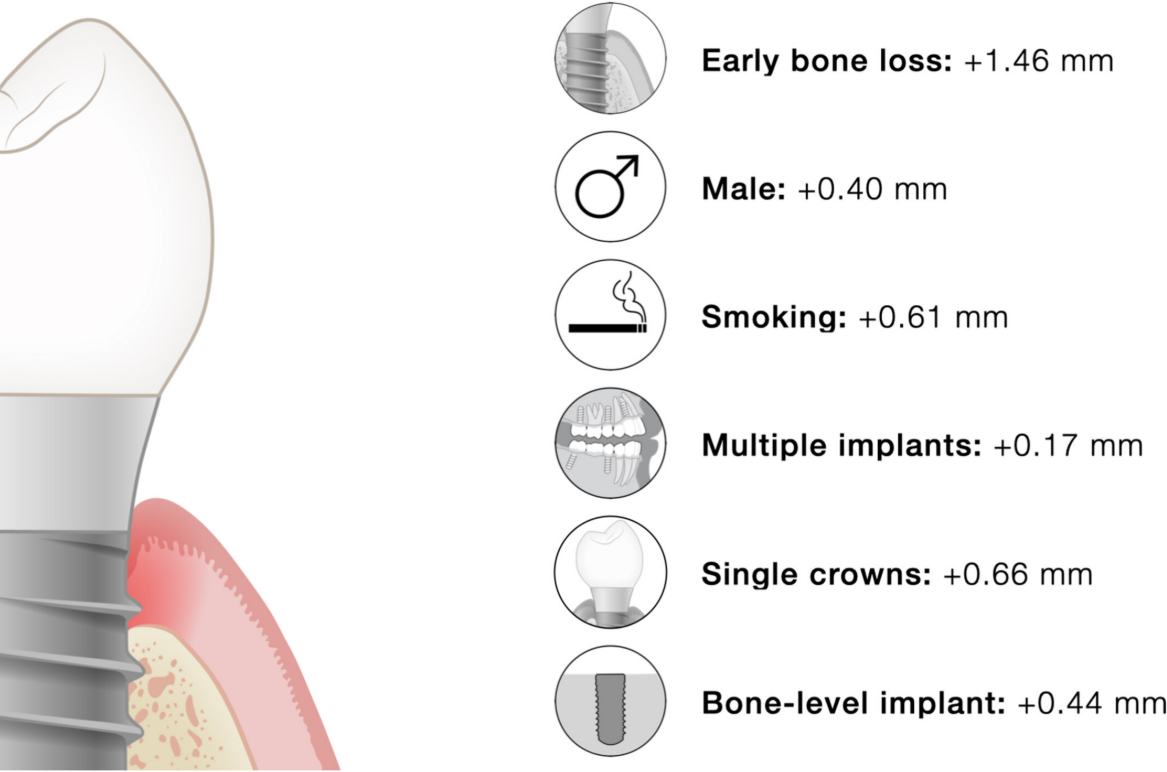
Variables associated with progressive radiographic bone loss.
Additional risk factors
Multivariate analysis showed:
- ERBL was the strongest predictor of further bone loss (+1.46 mm).
- Male gender was associated with greater bone loss (+0.40 mm).
- Smoking increased bone loss by +0.61 mm.
- Each additional implant in the oral cavity added +0.17 mm.
- Single crowns were associated with an additional +0.66 mm of bone loss, and bone-level implants with +0.32 mm.
These findings echo broader evidence that prosthetic and anatomical factors shape marginal bone loss around implants over time.
Table 1. Key indicators in two groups
| Indicator | ERBL+ | ERBL- |
|---|---|---|
| Mean bone loss (final) | -2.3 mm | -0.5 mm |
| Implant survival | 67.8% | 98.3% |
| Peri-implantitis (implants) | 63.2% | 5.2% |
| Peri-implantitis (patients) | 68.4% | 6.1% |
| Peri-implant mucositis | 19.5% | 59.2% |
| Healthy tissue | 17.3% | 35.6% |
Thus, the results convincingly show that the presence of early radiographic bone loss before prosthesis placement dramatically increases the risk of long-term complications, ranging from progressive resorption to implant failure.
Discussion
The study results demonstrate a clear and statistically significant association between early radiographic bone loss (ERBL) and long-term outcomes of implant treatment. In fact, the presence of ERBL was the strongest predictor of progressive bone resorption, implant failure, and the development of peri-implantitis.
The importance of ERBL as a predictor
- In the ERBL+ group, the mean bone loss was more than four times higher than in the ERBL- group.
- Implant survival rates decreased by almost a third, while the incidence of peri-implantitis increased more than tenfold.
- These data support the authors’ hypothesis: early changes in bone level before prosthetic loading are critical for long-term stability.
Comparison with previous studies
- Previous study by Windael and Galindo-Moreno showed that bone loss ≥0.5 mm after prosthetic loading increases the risk of complications.
- This new study expands on this concept: even the changes recorded before the placement of the prosthesis have a long-term impact.
- Thus, ERBL can be considered an early marker of an unfavorable scenario, which is consistent with the trend in recent years in implantology to shift the emphasis toward early diagnosis.
The role of additional risk factors
Multivariate analysis showed that, in addition to ERBL, progressive bone loss is influenced by:
- Smoking — exacerbates resorption.
- Male sex — associated with greater bone loss.
- Number of implants — each additional implant increases the risk.
- Type of restoration — single crowns are more often accompanied by bone loss.
- Bone-level implants — demonstrate greater resorption compared to tissue-level implants.
These factors do not negate the key role of ERBL but show that the clinical picture is formed by a combination of conditions.
Practical significance for clinicians
Although the authors do not make direct recommendations, their work suggests some cautious conclusions:
- ERBL should be considered a high-risk signal requiring close monitoring.
- Patients with early bone loss require more careful monitoring of their implants in the long term.
- Taking into account additional factors (smoking, type of restoration, number of implants) helps to form a more complete picture of the prognosis.
Limitations of the study
- The retrospective design imposes limitations on establishing causal relationships.
- The difference in follow-up time between the groups (8.8 vs. 11.5 years) may have influenced the results.
- Despite the large sample size, the study was conducted in a single center, which limits generalizability.
Nevertheless, the strength of the statistical differences and the consistency with previous data make the findings compelling.
Thus, the study highlights: Early radiographic bone loss before prosthetic loading is not just a local change, but a factor that can determine the fate of the implant for a decade. For practitioners, this means that early radiographic findings need to be carefully considered, even if the implant appears clinically stable.
Conclusions
This study convincingly demonstrated that early radiographic bone loss (ERBL), recorded even before the final prosthesis is placed, is a key factor determining the long-term fate of the implant.
Key observations
- ERBL as a predictor: The presence of early resorption dramatically increases the risk of progressive bone loss, peri-implantitis, and implant loss.
- Implant survival: In the ERBL+ group, it was only 67.8%, while in the ERBL- group, it was 98.3%. These figures are in line with the high long-term survival reported for modern conical implants in five-year follow-up when early resorption is absent.
- Peri-implant diseases: Peri-implantitis occurred in more than 60% of implants with ERBL, compared to 5% without it.
- Risk factors: Smoking, male gender, multiple implants, single crowns, and bone-level implants increased bone loss.
Practical implications for clinicians
- ERBL can be viewed as an early marker of a poor prognosis, requiring increased vigilance.
- Even with a clinically stable implant, radiographic signs of early resorption should be a cause for concern and prompt more careful monitoring.
- Taking into account additional risk factors helps to form a comprehensive understanding of the prognosis and long-term stability of implants.
- It is important to remember that peri-implant mucositis was more common in the ERBL- group, but it was early bone loss that determined the transition to severe forms of the disease.
Overall significance of the study
The work by the authors from Bern, Michigan, and Granada expands on existing data and shifts the focus to an even earlier stage of diagnosis. While attention was previously focused on bone changes after prosthesis placement, it is now clear: The condition of the bone tissue can play a decisive role even before the final prosthesis is placed.
For practicing implantologists and oral surgeons, this means that careful attention must be paid to early radiographic data and their interpretation in the long term.
Source
Effect of Early Radiographic Bone Loss Before Loading on Implant-Related Outcomes: A Long-Term Retrospective Study — First published: 25 February 2026, Clinical Oral Implants Research.

-
Hot
-
Hot
-
-