 USA
 Austria
 Belgium
 Bulgaria
 Croatia
 Cyprus
 Czech Republic
 Denmark
 Estonia
 Finland
 France
 Germany
 Greece
 Hungary
 Ireland
 Israel
 Italy
 Latvia
 Lithuania
 Luxembourg
 Malta
 Netherlands
 Poland
 Portugal
 Romania
 Slovakia
 Slovenia
 Spain
 Sweden
 Ukraine
Trueness of Dental Implant Placement Using Dynamic Navigation or Non-Guided Approach by Novice Surgeons: A Randomized, Controlled Clinical Trial
Contents
Accurate placement of dental implants is a key factor in successful prosthodontic rehabilitation. Even if the implant integrates into the bone, surgical errors can lead to serious problems later: difficulties in fabricating the prosthesis, occlusion problems, aesthetic defects, or damage to adjacent structures.
The classic method of implant placement without navigation relies entirely on the surgeon’s experience. While it remains familiar and reliable for experienced specialists, for novice surgeons, this approach carries a high risk of deviation from the planned position. As a result, treatment predictability suffers, and the risk of complications increases.
Modern navigation technologies have become the answer to this challenge. Dynamic navigation (d-CAIS) allows the surgeon to see the position of the instrument and the implant in real time and make adjustments directly during surgery. Unlike static surgical guides, which fix the plan and limit flexibility, the dynamic system allows for adaptation to the patient’s anatomical features.
For novice practitioners, this is not only a way to improve precision but also a learning tool. Working with navigation shortens the learning curve, builds confidence, and helps them quickly reach a level of skill comparable to that of experienced implantologists.
The comparison of these two approaches—unguided and dynamic—became the subject of a randomized clinical trial published in the journal Clinical Oral Implants Research (Ruiz-Romero et al., 2026). The authors assessed the accuracy of implant placement by novice surgeons, as well as the impact of the method on surgical time, safety, and patient perception of the procedure. We decided that this work merited a review article and would be useful for Uniqa Dental clients.
Study methodology
In order to objectively compare the accuracy of implant placement using dynamic navigation and the unguided approach, the authors conducted a randomized clinical trial at the University of Barcelona.
Study design
- Format: Open-label, parallel-group, two-arm RCT.
- Participants: 60 patients requiring 72 implants.
- Randomization: Allocation to groups was done in a 1:1 ratio using sealed envelopes.
- Operators: The surgeries were performed by second-year master’s students in oral surgery and implantology, who had no prior experience with implant placement. All had undergone preliminary training on phantom models and had worked as assistants.
Patient characteristics
Inclusion criteria: Age over 18 years, no need for bone grafting, satisfactory oral hygiene.
Exclusion criteria: Smoking more than 10 cigarettes per day, alcohol abuse, active periodontitis, pregnancy, participation in other RCTs.
Table 1. Main characteristics of patients by groups
| Parameter | Unguided approach | d-CAIS |
|---|---|---|
| Number of patients | 30 | 30 |
| Mean age | 52.8 years | 57.2 years |
| Females | 50% | 53% |
| Smokers | 23% | 10% |
| Implant location | 36% maxilla / 64% mandible | 31% maxilla / 69% mandible |
| Tooth position | 39% premolars / 61% molars | 25% premolars / 75% molars |
Systems used
- Navigation: X-Guide (X-Nav Technologies, USA), using optical markers and a radiographic X-Clip.
- Software: DTX Studio Implant for planning.
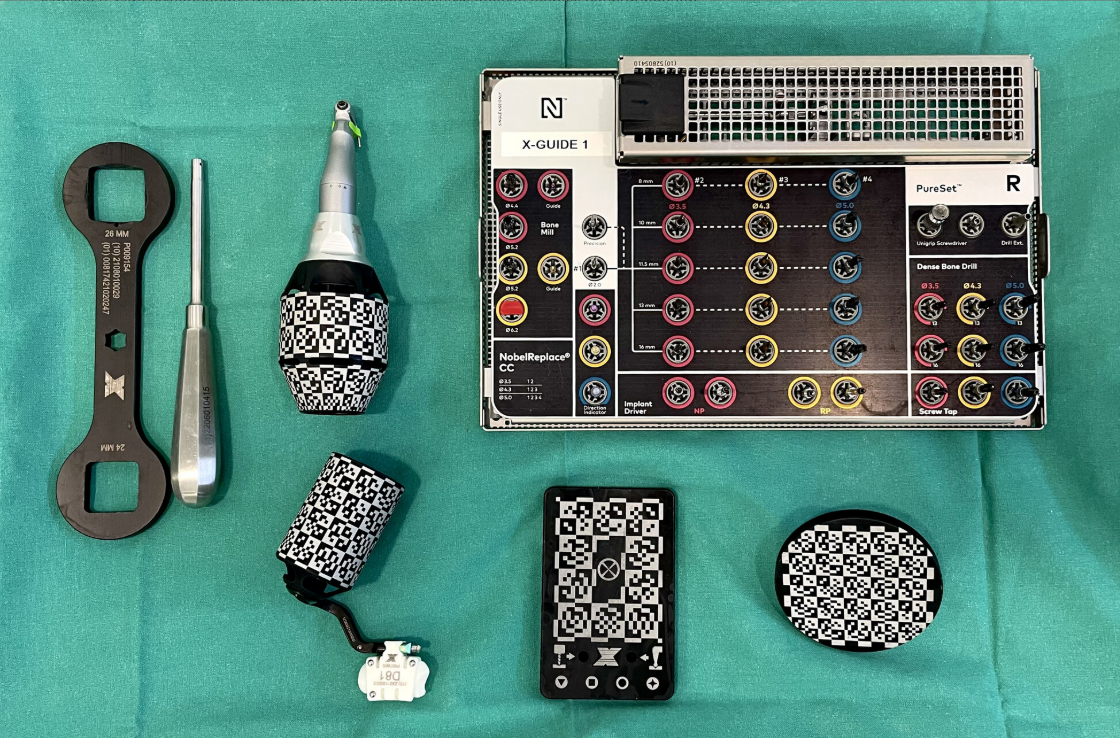
Surgical field with the oral surgery instruments: the handpiece with an optical marker, the X-Clip with its optical marker, and the various optical markers used for registration.
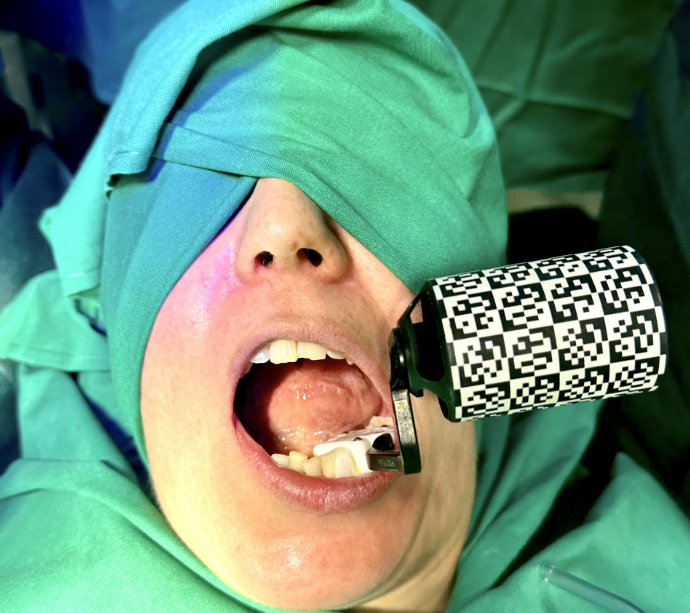
Preassembled radiographic X-Clip and optical marker fixed to the patient’s teeth.
Protocol
- Both groups underwent standard preoperative assessment, CBCT scanning, and digital planning.
- In the d-CAIS group, surgeons used X-Guide for real-time navigation.
- In the control group, implants were placed according to the classic protocol without navigation.
- After the operation, a postoperative CBCT was performed to assess accuracy.
Thus, the study was designed to minimize the influence of surgeon experience as much as possible and focus on comparing the technologies.
Main results: patient outcomes
The study’s authors paid special attention not only to the accuracy of implant placement but also to the patients’ perception of the procedure. This is an important aspect, as surgical precision must be combined with comfort and safety.
Pain and analgesic use
- The intensity of pain after surgery in both groups was moderate (VAS < 40 mm).
- Peak pain occurred between 2 and 24 hours after the intervention, followed by a gradual decrease.
- No significant differences were found between the groups: dynamic navigation neither decreased nor increased the level of pain compared to the unguided method.
- The consumption of analgesics (ibuprofen and paracetamol) was also comparable. In both groups, patients took the medications most frequently in the first few days, after which the need decreased.
Quality of life (OHRQoL)
- Changes in the OHIP-14 scale scores were minimal and statistically insignificant.
- Patients reported a slight decrease in quality of life in the first days after surgery, which is typical for the healing period, but there were no differences between the methods.
- After a week, the scores returned to baseline levels.
Patient satisfaction
- Overall satisfaction with the procedure was high in both groups.
- Patients who had implants placed using d-CAIS showed a greater willingness to pay for the procedure (the average difference was almost 100 euros).
- The perception of the procedure’s duration was interesting: most patients considered the time to be acceptable, but in the d-CAIS group, there was a tendency to perceive the procedure as taking longer.
- Regardless of the method, patients expressed a willingness to recommend the treatment to friends and relatives.
Table 2. Patient indicators by groups
| Parameter | Unguided approach | d-CAIS |
|---|---|---|
| Mean pain score (VAS) | < 40/100 mm | < 40/100 mm |
| Peak pain | 2–24 hours | 2–24 hours |
| Consumption of analgesics | Similar | Similar |
| Change in quality of life (OHIP-14) | Minor | Minor |
| Overall satisfaction | High | High |
| Willingness to pay more | – | + ~100 € |
| Perception of procedure duration | Acceptable | Slightly longer |
Thus, the study showed that dynamic navigation does not affect pain levels or quality of life, but it does increase the subjective value of the procedure for patients. They are willing to pay more for technology associated with greater precision and a modern approach.
Discussion
The results of the study by Ruiz-Romero et al. (2026) confirm what has already been repeatedly noted in the literature: dynamic navigation improves the accuracy of implant placement without negatively affecting patient acceptance of the procedure. However, it is especially important to consider these data in a broader context—both clinical and educational.
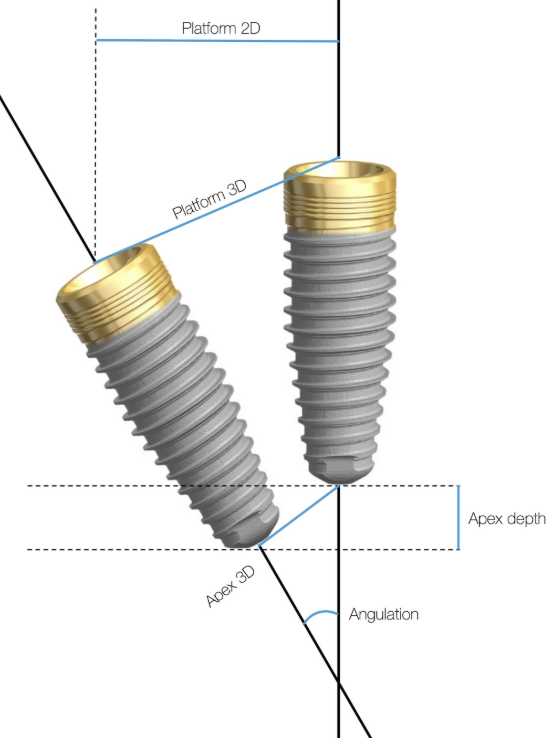
The variables used to measure implant placement accuracy: angular deviation and coronal and apical linear deviations.
Accuracy and clinical predictability
The reduction of angular and linear deviations when using d-CAIS means more precise compliance with the treatment plan. For the practitioner, this is directly related to the prosthodontic phase: the closer the implant is to the planned position, the simpler and more reliable the prosthetic restoration will be. Errors in the unguided method most often become apparent at the manufacturing stage, when compromises in the prosthesis design must be made.
Educational value
A unique feature of this study is the participation of novice surgeons. For them, navigation became not only a tool for improving accuracy but also a learning tool. The system displays the position of the instrument in real time, which helps the surgeon develop spatial awareness and confidence in their actions. This shortens the learning curve and allows for a more rapid achievement of a skill level comparable to that of experienced specialists. In the literature, navigation is increasingly viewed as a pedagogical resource that can change the approach to training implantologists.
Patient indicators
Interestingly, dynamic navigation did not reduce pain levels or the need for analgesics, but it did increase the subjective value of the procedure. Patients were willing to pay more for technology associated with a modern and precise approach. This reflects a trend: the perception of innovation plays a significant role in building trust in the treatment.
Comparison with other studies
Systematic reviews and meta-analyses in recent years (Yu et al., 2023; Wei et al., 2021) confirm that d-CAIS reduces angular and platform deviations compared to the unguided method and static surgical guides. In clinical practice, this translates into fewer complications—such as damage to adjacent teeth, nerves, or sinuses. This study adds an important insight: these benefits are maintained even by inexperienced surgeons, making the technology particularly valuable for educational programs.
Limitations
The authors note that the study was conducted on a limited sample size and involved students. Long-term outcomes (such as implant survival after several years) were not assessed. Furthermore, patients in the d-CAIS group were slightly older, which may have impacted their perception of the procedure.
Thus, the discussion demonstrates that dynamic navigation is not just a tool for improving accuracy, but also a teaching aid that has the potential to transform the training standards for implantologists. Patients perceive it as valuable, and clinical data confirms a reduced risk of errors.
Practical implications for dentists
The results of the study show that the use of dynamic navigation directly impacts the clinical outcomes of implant placement.
Precision and the prosthodontic phase
The main advantage of d-CAIS is the reduction in deviations from the planned position. For the practitioner, this means:
- Simplified prosthodontics: Less need for complex custom abutments or compromised solutions.
- Reduced risk of complications: Less risk of damage to adjacent teeth, nerves, or the maxillary sinus.
- Predictability of the result: The prosthodontic phase proceeds according to plan, without unexpected adjustments.
Impact on safety
No complications were recorded in either group in the study. However, fewer deviations when using navigation mean a reduced likelihood of critical errors in real-life practice. This is especially important when working in areas with limited space or near anatomically significant structures.
Surgical time
Although the overall duration of the procedure did not differ statistically, the implant placement phase itself was shorter with navigation. For the clinic, this means a more efficient use of time and resources, and for the patient, less surgical intervention.
Patient perception
Navigation doesn’t reduce pain, but it does increase the perceived value of the treatment. Patients are willing to pay more for a procedure that is perceived as more modern and precise. This reflects a trend: innovative technologies increase trust in the clinic and the doctor.
Table 3. Practical significance of navigation for clinical outcomes
| Aspect | Unguided approach | d-CAIS |
|---|---|---|
| Placement accuracy | Average, depends on experience | High, even for beginners |
| Prosthodontic phase | Difficulties may arise | More predictable |
| Risk of complications | Higher | Lower |
| Implant placement time | Longer | Shorter |
| Patient perception | Acceptable | A modern and precise approach |
Thus, the practical value of navigation extends beyond training. It ensures accuracy, reduces the risk of errors, and makes the prosthodontic process more predictable. For patients, it is a technology associated with quality and cutting-edge treatment, and for clinics, it is a tool for increasing efficiency and trust.
Conclusion
The study by Ruiz-Romero et al. (2026) demonstrated that dynamic navigation during implant placement provides greater accuracy, even for novice surgeons. This is a key finding that has a direct impact on clinical outcomes: accurate implant placement facilitates the prosthodontic phase, reduces the risk of complications, and makes treatment more predictable.
It is important to note that navigation does not increase the overall duration of the procedure or affect pain levels or quality of life. Subjective sensations after the procedure were comparable in both groups. However, patients who had implants placed using navigation rated the procedure higher and expressed a willingness to pay more for the use of modern technology. This underscores not only the clinical but also the marketing value of this method.
An additional finding of the study was the confirmation of the educational role of navigation. For novice surgeons, the system has become a tool that shortens the learning curve and builds confidence. Thus, d-CAIS can be viewed not only as a technology for improving accuracy but also as a means of training the next generation of specialists.
Key findings of the study:
- Placement accuracy: d-CAIS reduces angular and linear deviations compared to the unguided method.
- Clinical safety: No complications were registered; the implants were stable during placement.
- Patient indicators: Pain levels and quality of life are comparable; satisfaction is high.
- Perception of technology: Patients are willing to pay more for navigation.
- Educational value: Navigation shortens the learning curve and increases confidence in novice surgeons.
Dynamic navigation is thus becoming an essential element of modern implantology. It combines clinical precision, safety, and educational potential, while also fostering positive patient perceptions. All of this makes this technology a significant step toward standardizing and advancing implant practice.
Source
Trueness of Dental Implant Placement Using Dynamic Navigation or Non-Guided Approach by Novice Surgeons: A Randomized, Controlled Clinical Trial — Clinical Oral Implants Research — First published: 16 March 2026.

-
Hot
-
Hot
-
-