 USA
 Austria
 Belgium
 Bulgaria
 Croatia
 Cyprus
 Czech Republic
 Denmark
 Estonia
 Finland
 France
 Germany
 Greece
 Hungary
 Ireland
 Israel
 Italy
 Latvia
 Lithuania
 Luxembourg
 Malta
 Netherlands
 Poland
 Portugal
 Romania
 Slovakia
 Slovenia
 Spain
 Sweden
 Ukraine
Prosthetic Outcomes of Implant-Assisted Maxillary Restorations in the Edentulous Maxilla: A Review of a Meta-Analysis
Contents
Rehabilitation of the completely edentulous maxilla remains one of the most challenging tasks in implantology: limited bone volume, pneumatization of the maxillary sinuses, inferior bone quality compared to the mandible, and high patient expectations for aesthetics and function. Modern options—from bar-retained overdentures to fixed full-arch restorations (including full-arch 4)—provide good results but require an understanding not only of implant survival but also of the prosthesis life cycle: the frequency of interventions, the risk of prosthesis loss, and its impact on the patient’s quality of life. Therefore, we decided to share the results of a study published in the journal Clinical Oral Implants Research by Dr. Ethan Ng’s team.
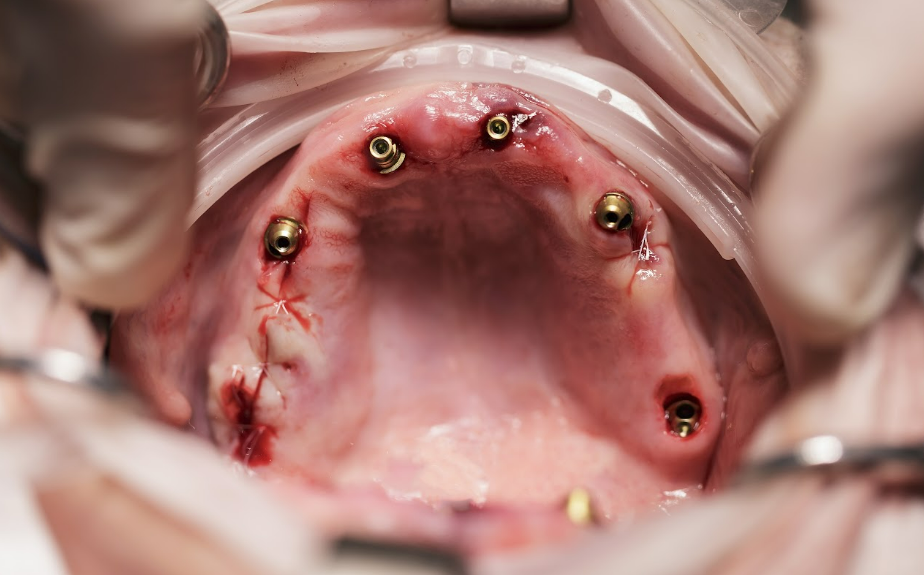
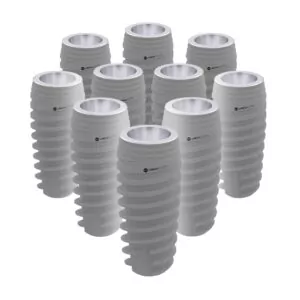
Clinical view of implant components placed for prosthetic rehabilitation of the completely edentulous maxilla.
Brief summary of the study
The aim of the review by the team of specialists is to provide practicing clinicians with a clear picture of prosthetic outcomes in the rehabilitation of the completely edentulous maxilla using implant-assisted restorations with a minimum of 3 years of follow-up. The authors collected and analyzed prospective studies and randomized controlled trials to answer the key question: How often are prostheses and implants “lost,” and how often is prosthetic intervention required after the restoration is delivered?
In the authors’ own words: “A total of 20 studies involving 913 patients were included.” This means that the conclusions are based on a relatively large body of clinical data rather than isolated case series. The main practical conclusion that runs through the entire review can be summarized as follows: Complete loss of a prosthesis or implant is rare, but the need for technical and prosthetic interventions is common. The authors emphasize this with two key indicators: prosthesis loss — 4.6%, whereas complication-free prosthesis survival — 61.9%, meaning that approximately one-third of patients experience at least one intervention requiring prosthesis correction during the observation period.
Why is this important for a practicing dentist?
- The patient expects “longevity”, but this often implies the absence of major complications; the reality is frequent minor repairs and adjustments.
- Treatment planning should take into account not only the choice of the implantation scheme and type of prosthesis but also the predicted need for maintenance and repairs.
- Informed consent and a follow-up program (maintenance) are key elements of successful long-term rehabilitation.
Methodology
- Design: RCTs and prospective clinical trials were included (20 articles, 913 patients).
- Criteria: At least 5 patients in the study and a follow-up of ≥3 years.
- Main outcomes (ID-COSM): Prosthesis loss (primary), implant loss, complication-free prosthesis survival, complication-free implant survival, technical complications, marginal bone loss, PROMs (Patient-Reported Outcome Measures).
- Analysis: Random effects for proportions; accounting for intrapatient clustering of implants (ICC), stratification by prosthesis type (fixed vs. removable) and by follow-up time (3–6 years and ≥10 years).
- Quality of evidence: Overall low/very low GRADE for most outcomes due to heterogeneity and reporting limitations.
Understanding these points is important: many of the findings are aggregated, with high heterogeneity between studies, so applying them to a specific clinical case should be done with caution.
Key findings (practice summary)
| Indicator | Value (pooled) | Comment |
|---|---|---|
| Number of included studies/patients | 20 / 913 | RCT + prospective studies |
| Prosthesis loss (all types, 3–10 years) | 4.6% (95% CI 1.2–10.1%) | Low absolute incidence of catastrophic outcomes |
| Complication‑free prosthesis survival | 61.9% (95% CI 48.4–74.5%) | About 38% of prostheses require at least one intervention |
| Complication-free implant survival (patient level) | 46.5% (95% CI 21.1–72.9%) | Frequent events at the patient level; implant level is better |
| Pooled implant loss (with clustering accounted for) | ~5.5% | Consistently low implant loss |
| Technical complications (all types) | 62.9% (95% CI 42.4–81.2%) | Includes minor and major interventions |
| Average marginal bone loss (3–6 years) | ~0.78 mm | Within acceptable limits |
| PROMs | Improvements in quality of life have been noted, but the assessment tools differ | Cannot be directly compared between studies |
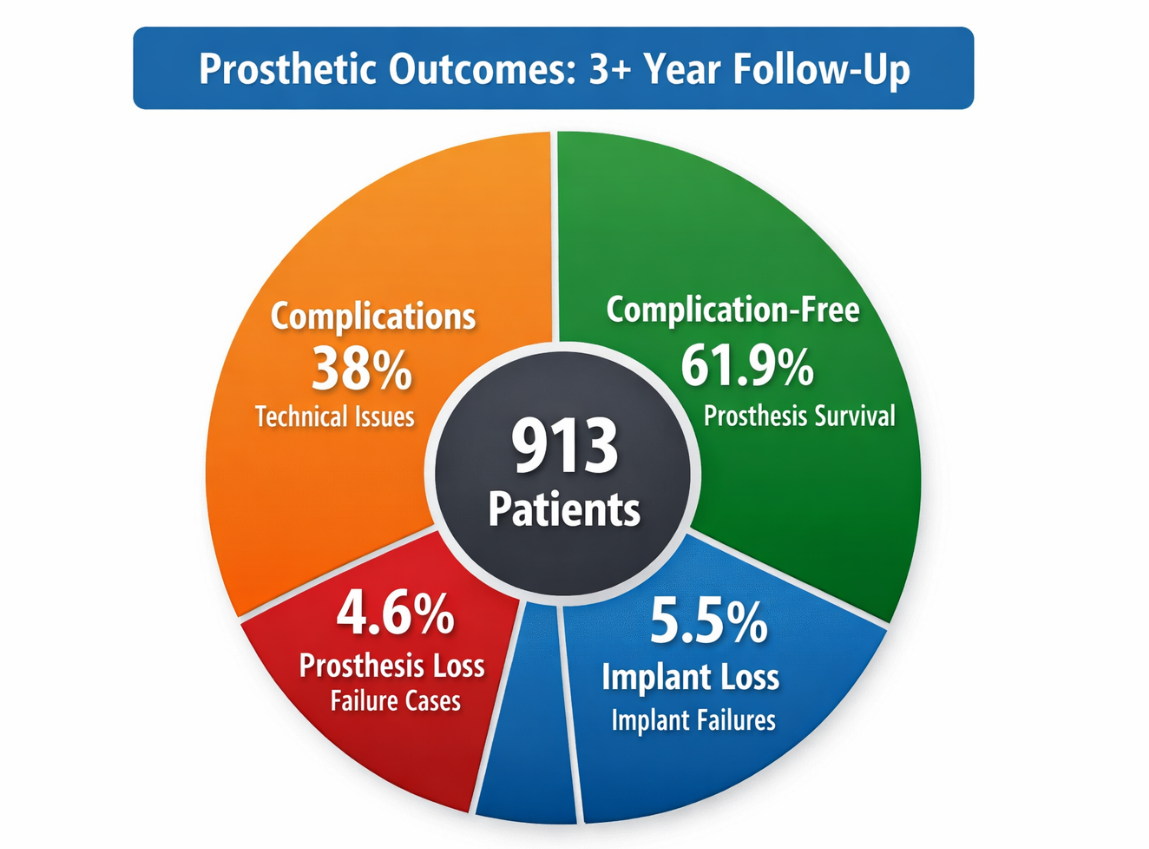
Green (61.9%) — Complication-Free Prosthesis Survival. Orange (38%) — Complications / Technical Issues. Red (4.6%) — Prosthesis Loss / Failure Cases. Blue (5.5%) — Implant Loss / Implant Failures. In the center: 913 patients.
What exactly breaks most often?
- Fixed metal-acrylic prostheses (PMMA on metal): Frequent cracks/delamination of the acrylic veneer (~41% of cases), rare ceramic chipping in PFM restorations (~2.8%).
- Overdentures: Frequent base repairs/tooth replacements and relining (high proportion of minor interventions); bar attachments were used more often, Locator attachments less often.
- Screw/abutment problems: They occur, but less frequently than veneer chipping and breakages.
Practical implications for the clinician: What to consider in patient planning and management
A brief checklist for planning maxillary rehabilitation
- Assess the patient’s expectations in terms of aesthetics, function, and serviceability.
- Choose the type of restoration taking into account anatomy, financial capabilities, and the patient’s ability to undergo regular maintenance.
- If you are planning a fixed structure (PMMA on metal): Warn the patient about the high probability of veneer repairs and the need for periodic visits.
- If you choose overdentures: Discuss frequent minor repairs (denture base, teeth), but also simpler maintenance in some cases.
- For immediate loading: Apply strict selection criteria (adequate primary stability, implant surface, absence of serious systemic risks).
- Plan your maintenance program: Regular examinations, professional hygiene, occlusion control, and checking of attachments and components.
Decision-making algorithm (abbreviated)
- Assessment of the clinical picture (bone, sinuses, soft tissues).
- Discussion of expectations and budget.
- Choice of prosthetic concept (fixed vs. removable).
- Risk assessment of technical complications and maintenance planning.
- Informed consent with an emphasis on the likelihood of repairs rather than the loss of the prosthesis.
Implant-assisted rehabilitation of the edentulous maxilla requires not only surgical precision but also strategic planning of the prosthetic component. A systematic review found: Loss of a prosthesis or implant is rare, but minor and moderate breakages and complications are quite common. This means that it is important for the clinician to prepare the patient in advance for regular maintenance and adjustments, rather than promising a “perfect prosthesis and lifelong stability.”
Treatment planning checklist
- Patient expectations: Discuss aesthetics, chewing function, and readiness for regular visits.
- Selecting the type of restoration: Consider the anatomy (bone volume, sinuses), financial capabilities, and the patient’s ability to maintain oral hygiene.
- Fixed structures: Warn the patient about the high risk of cracks and repairs to the acrylic veneer; encourage regular visits.
- Overdentures: Explain that minor repairs (teeth replacement, relining of the denture base) will be regular occurrences, but ultimately this is easier and cheaper than fixing large-scale damage.
- Loading protocol: Immediate loading has quite a few contraindications and is only permissible with high primary stability and the absence of systemic risks.
- Maintenance program: Regular examinations, professional hygiene, occlusion control, checking of screws and abutments.
Possible decision-making algorithm (not a guide to action)
- Clinical evaluation: Bone volume, sinus condition, soft tissues.
- Discussing expectations and budget: Open dialogue about possible repairs and maintenance costs.
- Selecting a concept: Fixed or removable design.
- Assessment of the risk of complications: Forecast of repair frequency, probability of technical problems.
- Informed consent: Emphasis on the fact that repairs are likely, but loss of the prosthesis is rare.
Practical emphasis
- The patient must understand that implant-assisted rehabilitation is not a “once and for all” solution, but a system that requires regular maintenance, like a house or a car.
- The clinician succeeds if they establish realistic expectations for the patient in advance: rare loss of the prosthesis, but frequent minor interventions.
- The prosthodontist and surgeon must work together to select the optimal concept and minimize the risk of complications.
Study limitations and practical caveats
- Heterogeneity of studies (different implant systems, loading protocols, materials) reduces the transferability of results to a specific practice.
- Reporting of the severity of complications is often missing: it is not always clear how many interventions are involved — a “single visit” or “multi-stage treatment.”
- PROMs were measured using different instruments, which limits comparison.
- Long-term data (>10 years) are limited (only a few studies), so predictions for decades are less reliable.
Conclusion
A systematic review shows: Loss of a prosthesis or implant during maxillary rehabilitation is rare, which means the basic reliability of the method has been confirmed. Yes, technical interventions are common, but they are precisely what maintain the structure in working order and extend its service life.
For a practicing clinician, this is not a reason for pessimism, but on the contrary, an opportunity to build a long-term partnership with the patient. If you explain upfront that a prosthesis is a “living system” requiring regular maintenance, the patient will perceive visits not as an unpleasant necessity, but as part of their self-care. This approach builds trust and increases satisfaction with treatment.
Optimistic accents
- Reliability of the method: Catastrophic outcomes are extremely rare.
- Service Predictability: Most interventions are minor repairs that are easy to carry out.
- Collaboration with the patient: Regular visits become preventative rather than “fighting problems.”
- Improving the quality of life: Even when repairs are necessary, patients report improved function, aesthetics, and overall well-being.
Practical takeaway
Implant-assisted maxillary rehabilitation is not a one-time procedure, but a joint project between the doctor and the patient. The doctor provides a reliable foundation, and the patient participates in regular care. Together, they achieve the most important thing—long-term stability and a high quality of life.
Source
Prosthetic Outcomes of Implant-Assisted Maxillary Restorations in the Edentulous Maxilla: A Systematic Review and Meta-Analysis: Ng E. et al.,Clinical Oral Implants Research, 2026; DOI: 10.1111/clr.70116.


-
Hot
-